
Content Strategy
Prediction: By 2027, More Than Half of Your Web Traffic Will Not Be Human

If you’re measuring “growth” by sessions alone, you’re about to have a bad time.
Over the next 12–24 months, more of what hits your site won’t be people at all. It’ll be a mix of crawlers, AI training bots, LLM-powered “agents,” scraping tools, uptime monitors, and automation systems fetching pages on behalf of users (or businesses) at machine speed.
My prediction: by 2027, 50%+ of total web requests for many B2B and content-heavy sites will be non-human—and unless you instrument for it, you’ll make the wrong decisions in SEO, ads, attribution, and site performance.
Important definition:
Human traffic = a person viewing and interacting in a browser/app.
Non-human traffic = automated requests (crawlers, bots, agents, monitors, scrapers).
Agent-driven traffic = automated requests that represent a user’s intent (“find X, compare Y, book Z”) even if no browser session occurs.
Why this matters for marketers and operators
When non-human traffic rises, three things break:
-
Your analytics gets noisier
Sessions, time on site, and “conversion rate” become less reliable if bots and agents are mixed with humans. -
Your SEO strategy changes
Ranking is no longer only “get humans to click.” It’s also: make your site readable to machines that summarize, compare, and recommend. -
Your site performance priorities shift
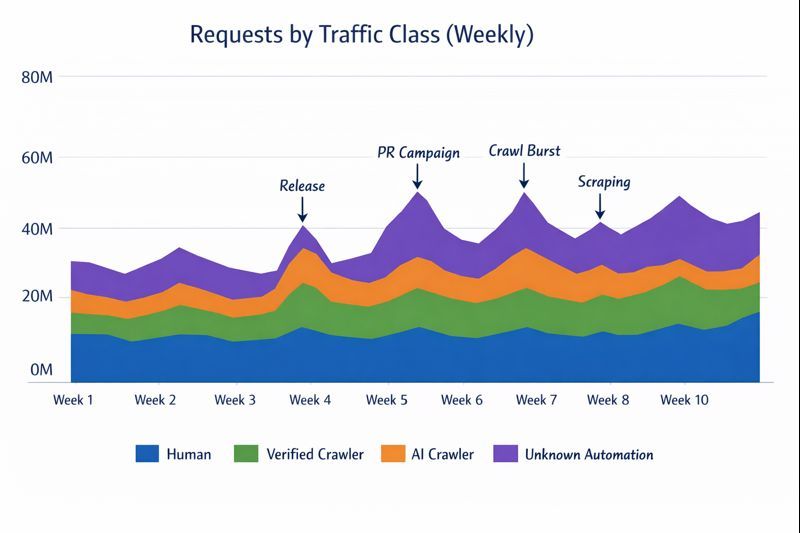
Bots can spike CPU, inflate CDN costs, and distort load tests. Your “peak traffic day” may not have been a campaign—it may have been a crawler.
What you should track (the new scoreboard)
Forget “sessions first.” Start with requests first:
Core metrics
-
% of requests by class: Human / crawler / agent / unknown
-
Top user agents (and their request volume)
-
Top endpoints hit by bots (and response codes)
-
Bot-induced cost: bandwidth, CDN, compute, WAF events
-
Human-only KPI set (what you report to marketing leadership)
A quick reality check:
If you can’t answer “what % of our requests are non-human?” from server logs, you’re guessing.
The detection stack (what to use, in order)
1) Server logs (source of truth)
Pull request logs from:
-
CDN (Cloudflare/Fastly/Akamai)
-
Load balancer (ALB/Nginx)
-
App server logs
Classify traffic by:
-
user-agent
-
IP / ASN patterns
-
request rate and path patterns
-
known bot lists and verified bot headers (when available)
Output: a weekly report: requests by class + top paths + top bots.
2) WAF / Bot management (control layer)
Use your WAF to:
-
challenge suspicious high-rate traffic
-
block obvious scrapers
-
rate limit “expensive endpoints”
-
allowlist verified crawlers you want
3) GA4 (impact + behavior, not truth)
GA4 is where you answer:
-
are humans engaging?
-
which content converts?
-
what channels drive meaningful behavior?
Do not rely on GA4 to quantify bot share—treat it as the human-experience lens, not the bot-detection engine.
Step-by-step: a 7-day “Non-Human Traffic” audit
Day 1: Pull logs + categorize requests
-
Export 7–14 days of logs
-
Create categories: verified crawlers, known AI crawlers, suspicious automation, human browsers
Deliverable: “% of requests non-human” + top 20 user agents.
Day 2: Find “bot magnets”
Bots typically hammer:
-
/blog/archives -
search pages (site search)
-
pricing pages
-
sitemaps
-
image endpoints
-
API routes (even if undocumented)
Deliverable: top 50 endpoints by request volume (non-human only).
Day 3: Protect expensive pages
-
Add rate limits to heavy endpoints
-
Add caching rules where appropriate
-
Use robots directives thoughtfully (for crawlers you control)
-
Ensure good response codes (stop serving 200s for trash requests)
Day 4: Separate human reporting from total reporting
Make two dashboards:
-
Total requests (ops view)
-
Human sessions and conversions (marketing view)
Your weekly marketing deck should not be inflated by bot spikes.
Day 5: “Machine-readable presence” upgrades
This is where SEO meets the agent era:
-
Add / improve structured data (Organization, Product, Article, FAQ, HowTo where applicable)
-
Ensure canonical tags + clean metadata
-
Publish “comparison-friendly” pages (clear pricing, features, FAQs, differentiators)
-
Make key pages fast and cacheable (bots will hit them too)
Day 6: Build an “Agent Ready” page template (optional but powerful)
Create a template for pages you want machines to “understand”:
-
short summary at top (“What it is, who it’s for, why it’s different”)
-
feature bullets (not just brand copy)
-
pricing + plan differences
-
integrations, compliance, support
-
FAQ in clean format
Day 7: Alerting and thresholds
Set alerts for:
-
sudden 2–3x increase in requests from unknown user agents
-
crawl spikes that degrade performance
-
expensive route abuse
Common mistakes to avoid
Mistake 1: Treating “traffic up” as “marketing success”
If requests rise but human conversions don’t, you may have a crawler wave.
Mistake 2: Blocking everything that isn’t human
Some crawlers help you (search engines, legitimate monitoring).
The goal is control + measurement, not “kill all bots.”
Mistake 3: Ignoring how agents will “choose” vendors
If AI assistants and agents summarize vendors, your content needs:
-
clarity
-
structured answers
-
proof points
-
pricing transparency (when possible)
-
comparison pages that don’t feel like fluff
Closing: the 2 actions I’d do today
-
Pull 14 days of server/CDN logs and classify traffic.
-
Build a “human-only KPI” dashboard so marketing decisions are based on people, not bots.

Derrick builds intelligent systems that cut busywork and amplify what matters. His expertise spans AI automation, HubSpot architecture, and revenue operations — transforming complex workflows into scalable engines for growth. He makes complex simple, and simple powerful.
Power Your 1-Person Marketing Team
Stop spending hours creating content. Klonyr helps you generate AI-powered content across 6 platforms, manage multiple brand voices, and automate your entire content strategy—so you can focus on growing your business.